
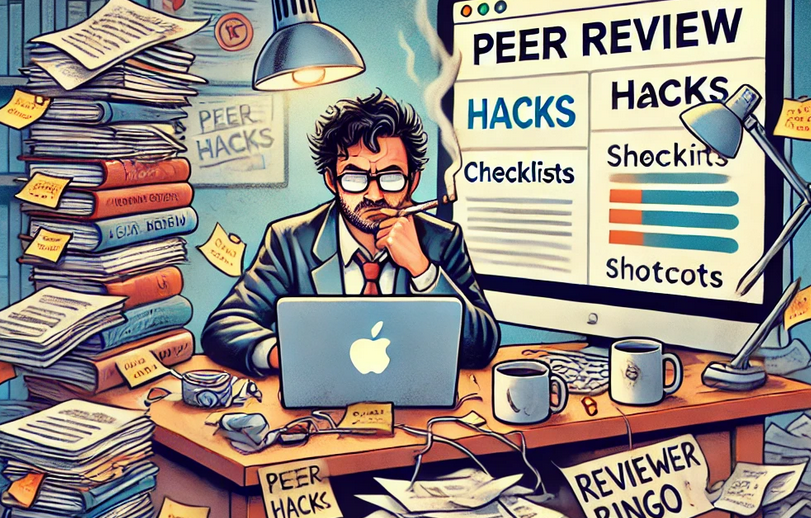
I had an exhausting and painful experience this year with reviews for recent top-tier SIGARCH conferences – the usual ISCA, ASPLOS, HPCA, MICRO. No I am not complaining about the reviewer load. It’s reading others’ reviews of papers I was reviewing – I found the process just draining and painful. To be clear, this is not from reading reviews of my papers – its just reading reviews of other papers that other reviewers wrote and their behavior. This was just draining in seeing the downright unprofessional oftentimes unethical behavior. Maybe this has just been a weird year for me in terms of co-reviewers I got binned with – or are others also feeling some of this too?
<ok spoiler alert> This is satire. Although TBH, I am not sure!
Some (a substantial portion) of my co-reviewers seemed to know things I just didn’t know about what this process is supposed to be. And I have been doing this for 15+ years, naively following Alan Smith’s seminal “Task of the Referee.” So, I wrote these lessons down in case others like me are also missing out on these tricks. If you are a person just starting out in academia, or like me haven’t kept up with the new rules of the game, read on…
I’m here to offer some advice on how you, as a junior reviewer, can make a name for yourself and rise through the ranks. This guide isn’t about the official process you’ll hear from senior faculty – (do your reviews on time, write meaningful reviews, find reasons to accept papers, no paper is perfect, see if the strengths outweigh the weaknesses). That is cliched useless nonsense for suckers. No, this is the real way to succeed and how to do it time efficiently.
1. Skip Reading the Paper (Why Bother?)
Let’s face it, your time is precious. You’ve got your own research to do, and a million deadlines. So, why read an entire paper when the abstract or the introduction gives you all the information you need? After all, if the authors did their job right, that one paragraph should sum up everything. Ok, if you are feeling you have time, read the introduction. Save yourself the hassle of wading through technical sections—make your judgments based on the abstract, and you’ll have plenty of time left over for more important things, like catching up on emails or lunch, or writing your own papers and proposals.
2. Respect Is Overrated: Dissect the Related Work
When it comes to the related work section, show no mercy. Sure, the authors think they’re building on some award-winning baseline, but that’s no reason for you to give it a free pass. Look for cracks, flaws, and oversights, even in the most celebrated papers. Talk to your fellow reviewers about how overrated the foundational work is, and soon you’ll be known as the one who’s willing to challenge the “sacred cows” of the field. Plus, nothing makes you sound more sophisticated than questioning widely accepted ideas. Don’t back down – if the paper you are reviewing is improving on an ISCA paper from 2022, and showing it is 40% better than that, argue why that ISCA 2022 paper is broken and should never have been published; feel free to advance any type of exotic claims on the published papers. This is a clever type of 3D chess, where you are not even discussing the merits of the paper being reviewed!
3. Deadlines? More Like Suggestions
The review deadline is looming—but don’t let that stress you out. Submit your review whenever you get around to it, and don’t worry too much about the discussion phase either. If the authors are anxiously waiting for feedback, well, that’s their problem, not yours. And if other reviewers give your papers the same treatment? Well, all’s fair in the game of academia, right? Everyone’s throwing as many submissions into the conference roulette as possible. Why take this whole peer review thing too seriously?
4. Write Vague Reviews—Then Go Wild in Discussion
A great way to minimize your workload is to write a short, non-committal review. Be polite, but don’t offer anything too specific—just enough to get the job done without triggering a back-and-forth debate. But once the rebuttal phase or program committee (PC) meeting kicks off, that’s your moment to shine! Suddenly remember a glaring issue that you “overlooked” before, and dig into it with all the vigor you can muster. Keep it niche and technical, ideally something the authors didn’t think was even relevant. They’ll be blindsided, and you’ll look like a true guardian of quality. And don’t worry, your co-reviewers and the program chair will go along with the ride – they won’t ask you why all this new stuff wasn’t in your review in the first place.
5. Find a Fatal Flaw and Run with It
Here’s a pro tip: the best way to make sure a paper doesn’t go through is to find one flaw, magnify it, and declare it “fatal.” Maybe the authors used an analytical model instead of a simulator. No matter if a prototype is years away from existing and validation is not possible—just say, “The lack of validation is a serious issue.” This critique will age like fine wine, usable over and over whenever similar papers come up. And if you’re struggling for inspiration, here’s a classic: criticize their use of an academic PDK, or ask whether they verified every post-synthesis netlist. If all else fails, just say the memory compiler used for SRAM and register files is flawed – industry would never do it this way. It’s a timeless technique to keep that reject button close at hand.
6. Industry Perspective? Reject All Results
If you’re coming from an industry background, your skepticism of academia’s results can be your greatest weapon. Whenever you see experimental results, just assume they’re off—no need to spend time checking the details. It’s easier that way! And when another reviewer from academia asks for more experimental data just stay silent. Why interfere with their quest for better data, which you deem is useless and not to be believed? We want a chaotic review process where randomness and reviewer assignments determine outcomes.
7. Make Exhausting Demands to Slow Everyone Down
The academic race is all about staying ahead, and what better way than by slowing down the competition? Ask for additional experiments, new benchmarks, or revisions that are tangential to the paper’s main contributions. And the absolute time tested classic: “the paper will benefit from an overhaul of the writing”. The more time the authors spend doing these pointless tasks, the less time they have to submit new papers to the next conference cycle. Plus, you’ll be able to sit back and enjoy the satisfaction of knowing you’ve kept the playing field level—especially when it tilts in your favor.
8. Strategic Silence: Save Your Thoughts for the PC Meeting
Why waste your time in online discussions when you can save up your insights for a more dramatic moment? When the discussion phase opens, stay quiet for most of it—maybe drop a line an hour before it closes, saying you’re really busy but will take a look at the paper when you can. Insist that the paper needs a full discussion at the Program Committee (PC) meeting. Then, once you’re at the meeting, that’s your moment to shine! Talk at length about every possible flaw you can think of. Just keep talking, until the PC chair cuts you off. This way, you’ll get the visibility you need in front of a large audience. Who cares if you’re taking up everyone’s time? It’s not about efficiency; it’s about making your presence felt. The best part? Now you’ve got 200 people on Zoom—whether they’re actually listening, walking their dogs, or doing who-knows-what while “attending” the meeting—tuning in to hear your insights. And you’ll come across as the reviewer who’s busy but still makes time for these “critical” discussions and is doing a conscientious job. The suckers who conscientiously did the online discussions with their valuable time and marked papers as online accept or reject, will listen in awe to your takedown of the paper. A true win-win!
Remember, junior colleague, reviewing is about more than just advancing science. It’s about power, prestige, and making sure your voice is heard—whether or not you’ve read the paper. Good luck, and may your reviews be short, your critiques be sharp, and your deadlines ever-flexible!
About the Author: Karu Sankaralingam is a Professor at UW-Madison, an Entrepreneur and Inventor. He is an IEEE Fellow and holds the Mark D. Hill and David Wood Professorship at UW-Madison. He is a recipient of the Vilas Faculty Early Career Investigator Award in 2018, Wisconsin Innovation Award in 2016, IEEE TCCA Young Computer Architecture Award in 2012, the Emil H Steiger Distinguished Teaching award in 2014, the Letters and Science Philip R. Certain – Gary Sandefur Distinguished Faculty Award in 2013, and the NSF CAREER award in 2009.
Disclaimer: These posts are written by individual contributors to share their thoughts on the Computer Architecture Today blog for the benefit of the community. Any views or opinions represented in this blog are personal, belong solely to the blog author and do not represent those of ACM SIGARCH or its parent organization, ACM.